Skip to content

Warm-white roofline lighting for Atlanta homes

A roofline in warm white is the most traditional Christmas display there is, and the easiest to get slightly wrong. Bulb size, spacing, color temperature, and which edges to trace all show from the street. We measure every run, cut commercial-grade LED strands to fit, and clip them on at an even spacing. Text a photo of the house for a free written quote.

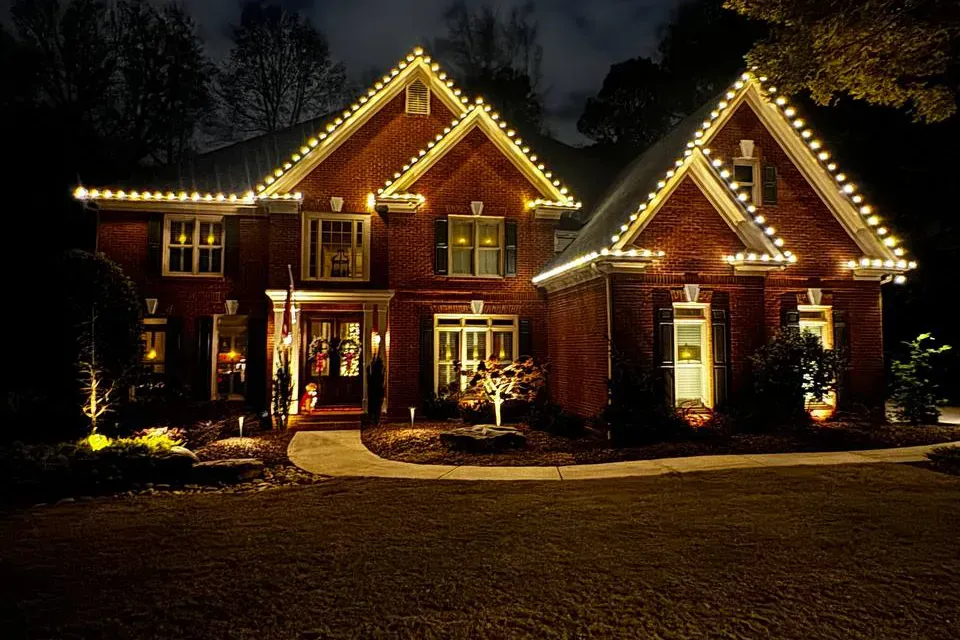
Brick colonial at night with warm-white C9 bulbs outlining both front gables and the lower roofline

Why warm white, and why the details matter

A roofline is a drawing of the house made in light. When it works, the eye reads the gables and the eave as clean lines against the night sky, and the house looks like itself, only more so. When it does not, the eye catches a sag at a corner, a gap where two strands meet, or one run that is a shade bluer than the rest. Almost every problem with a roofline display comes down to four choices: color temperature, bulb size, spacing, and which lines to trace.

Color temperature is the first. Warm white LEDs sit near 2700K, close to the color of an old incandescent bulb. Against red or painted brick, cream trim, and dark shutters, that warmth looks settled and deliberate. Cool white runs bluer, closer to moonlight, and it can look crisp on a white farmhouse or a modern gray exterior, but on older brick it tends to read as cold. That is why warm white is our starting point on most brick and stone houses, whether it is a 1990s traditional in Johns Creek or a 1920s Tudor intown, and our journal post on warm white vs. cool white on brick goes deeper with examples.

Bulb size comes next. The C9 is the large, faceted bulb most people picture on a roofline, and it holds its presence from across a wide lawn or up on a tall two-story gable. The C7 is smaller and softer, and it suits a porch roof, a cottage, or a bungalow that sits close to the sidewalk. Mini lights are for trees, shrubs, and garland, not rooflines, where they tend to disappear from any distance. Spacing is the rhythm. We usually hang C9s about a foot apart and keep that interval steady around corners and across seams, so the line reads as one continuous stroke.

Then there is the question of which lines. A two-story colonial with two front gables might carry light on both rakes and the lower eave and nothing on the back. A Morningside Tudor might need only its tall front gable. Every roofline plan we write names each run, so you can see exactly what will be lit before we arrive. If a roofline is one part of a larger plan, our residential design service puts it together with trees and greenery.
  • 2700K warm white by default

    Warm white suits brick and painted trim on most older houses. Cool white and multicolor are available when the house suits them.

  • C9 or C7, sized to the house

    C9s for tall gables and deep setbacks, C7s for porch roofs and houses seen up close from the sidewalk.

  • Even spacing, cut to length

    Strands are cut to each measured run and clipped at a steady interval, so there are no gaps at seams and no coils at the ends.

  • Nothing driven into the house

    Shingle clips and gutter clips hold the line. No staples, nails, or screws in fascia, brick, or trim.

The clip, up close

The clip, up close

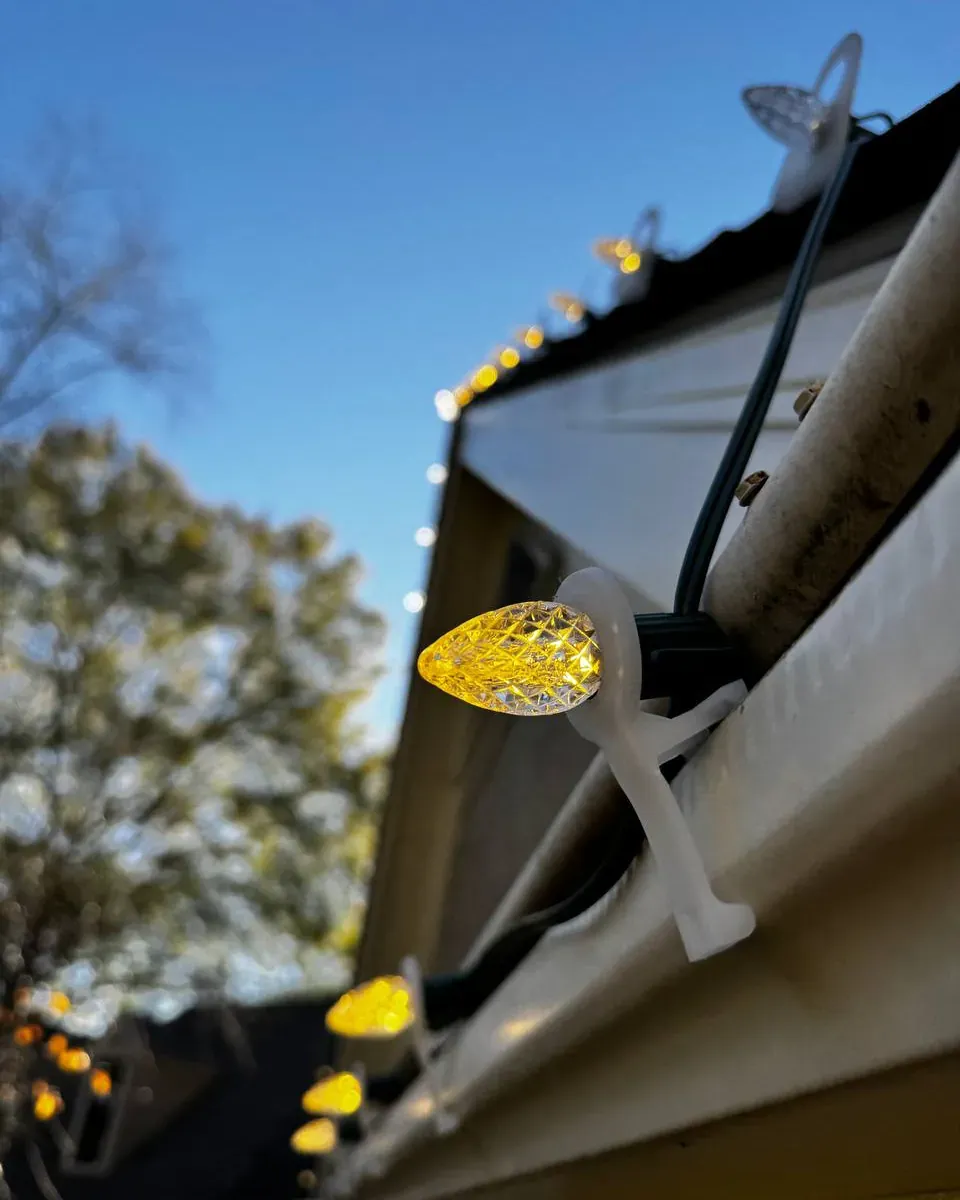
The close-up above shows a single C9 bulb held in a gutter clip in daylight. It is a small part, and it does most of the work. The clip grips the front lip of the gutter, holds the bulb upright so it faces the street, and sets the spacing without anything piercing the metal. On shingled edges without a gutter, a shingle clip does the same job by sliding under the shingle edge.

Because the clips set the angle, every bulb in a run points the same way. That consistency is a large part of why a professional roofline looks even from the curb and a hand-hung one often looks wavy.

Reading a two-story brick roofline

Reading a two-story brick roofline

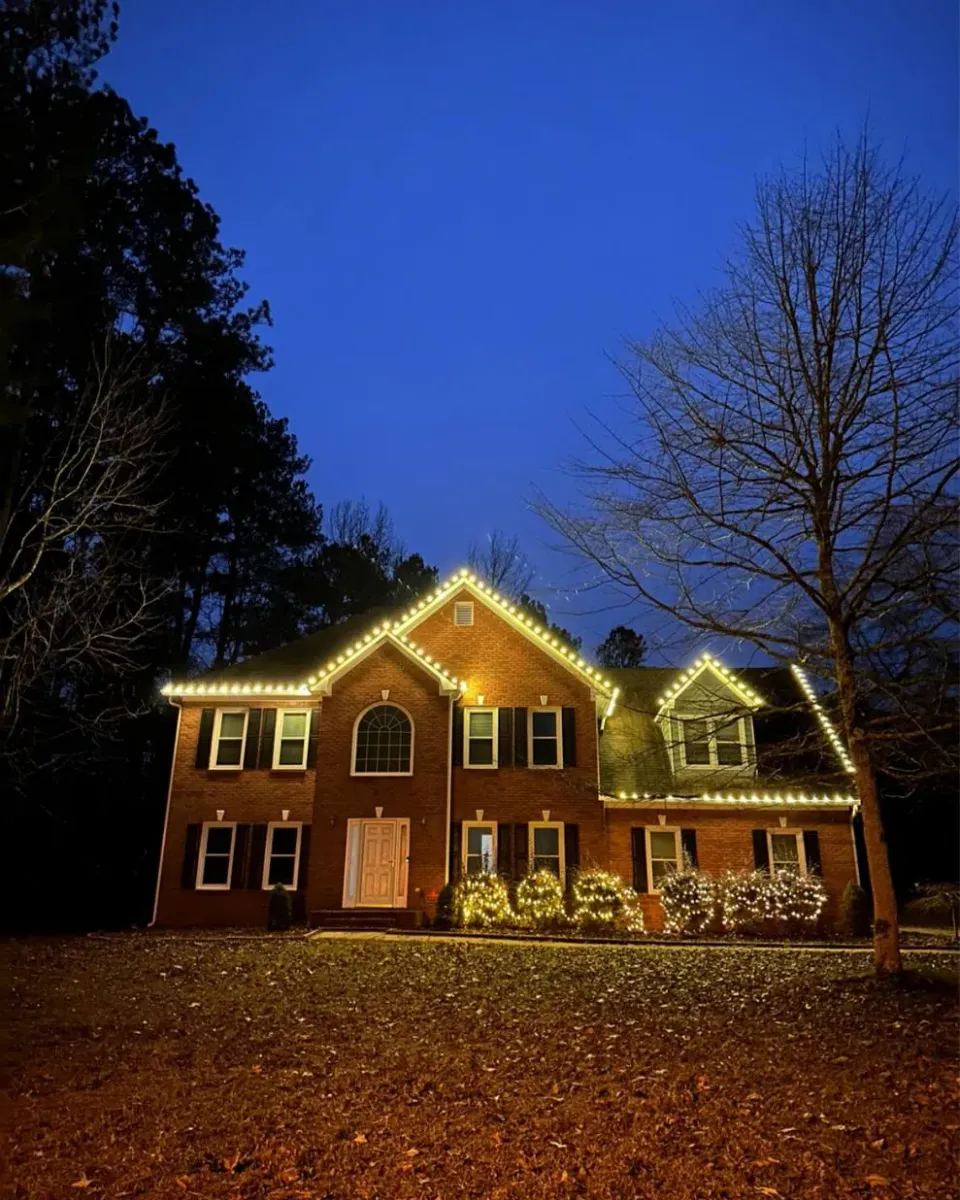
Two-story brick houses are the standard across Alpharetta and much of Roswell, and common in Buckhead and Brookhaven. They tend to have a main eave, one or two front gables, and often a dormer or a lower wing. On the newer North Atlanta traditionals, the tallest line is usually the gable over a two-story foyer, and it is the one that has to read cleanly, because it usually sits right above the front door. The blue-hour photo shows how a lit roofline and dormer work together with shrubs at the foundation: the upper lines give the house its outline, and the low light ties it to the ground.

On a house this size, C9s at a steady spacing hold their weight from the street. The brick reads warmer next to a 2700K bulb, and the trim reads crisper.

When cool white is the right call

When cool white is the right call

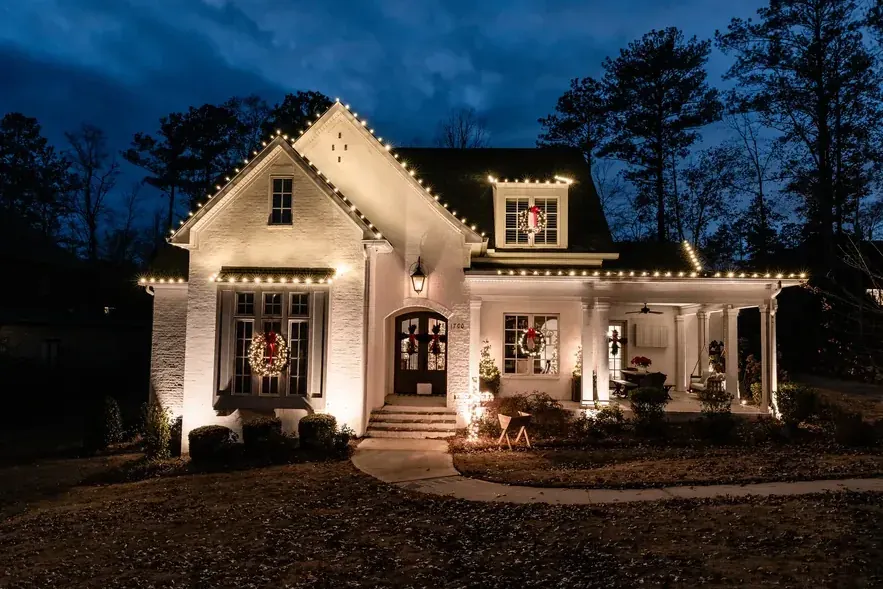
Warm white is a default, not a rule. A white-painted farmhouse, a newer infill house with dark windows and metal accents, or a family that simply loves the look of cool white can all be good candidates for it. The white farmhouse pictured carries warm white, and it shows how much the color of the siding shapes the result.

The one thing we avoid is mixing warm and cool whites on the same roofline by accident. When both appear in a design, they are separated on purpose, for example warm white on the roof and cool white on a tree.

Rooflines on older intown houses

Rooflines on older intown houses

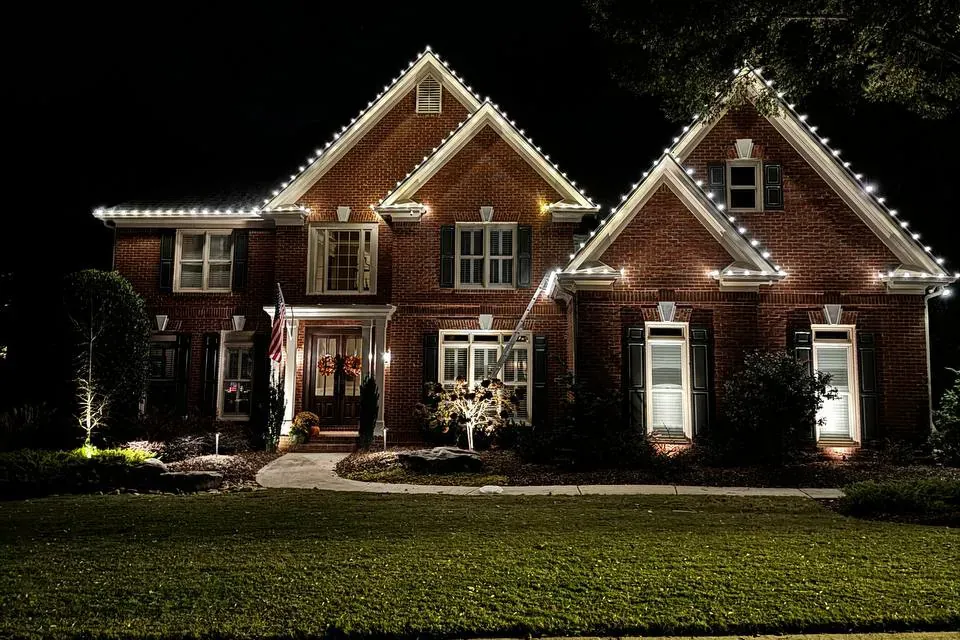
Older houses in Ansley Park and Inman Park often have slate, tile, or delicate original trim, along with rooflines broken by turrets, bays, and porches. For these we plan routes that clip only where the roof can take it and leave the rest to the architecture. The brick house pictured shows warm-white light on each gable with nothing added to the walls.

A roofline can also be one piece of a fuller design with wrapped trees and wreaths and garland. For those who want a roofline that stays up all year, the permanent roofline lighting page explains how that differs.

Roofline lighting questions

The choices that decide how a roofline reads from the street.

Should I pick warm white or cool white?

On red brick, stone, and cream or painted trim, warm white (around 2700K) usually looks right because it matches the warmth of the materials. Cool white can look sharp on a white farmhouse or a gray modern exterior. If you are torn, we can talk it through from your photo, and the journal post on the subject shows the difference.

What is the difference between C9 and C7 bulbs?

The C9 is larger and brighter and holds up from a distance, which is why it is the usual roofline bulb on two-story houses. The C7 is smaller and gentler and suits houses close to the street or a porch roof seen up close. Some homes use C9s on the main roof and C7s on the porch.

Can you light a steep roof or a tall gable?

Yes. Steep pitches and tall rakes take more time and equipment, which shows up in the quote, and a few very steep or fragile roofs are better served by lighting the lower eave and a wrapped tree instead. We will say so plainly when that is the better design.

How do the clips attach?

Shingle clips slide under the edge of the shingle, and gutter clips grip the front lip of the gutter. They hold the bulb upright at a set spacing and come off with the strands in January. Nothing is stapled, nailed, or screwed in.

What if a section goes dark in December?

Text a photo of the dark section to (470) 380-7797 and it goes on the next route. Commercial-grade strands with sealed sockets hold up well in wet weather, but when one fails, we replace it rather than asking you to climb up.

Get a roofline quote

Text a photo of the front of the house and the address to (470) 380-7797. We measure each run and send a free written quote that names every line, the bulb, the spacing, and the color. Earlier install dates fill first.

Email christmaslightsofatl@gmail.com

Or send the details here

All services
Text us (470) 380-7797

Text us a photo

Scan with your phone's camera to start a text to (470) 380-7797. Attach a picture of the front of the house.

QR code that starts a text message to (470) 380-7797
Use the quote form instead