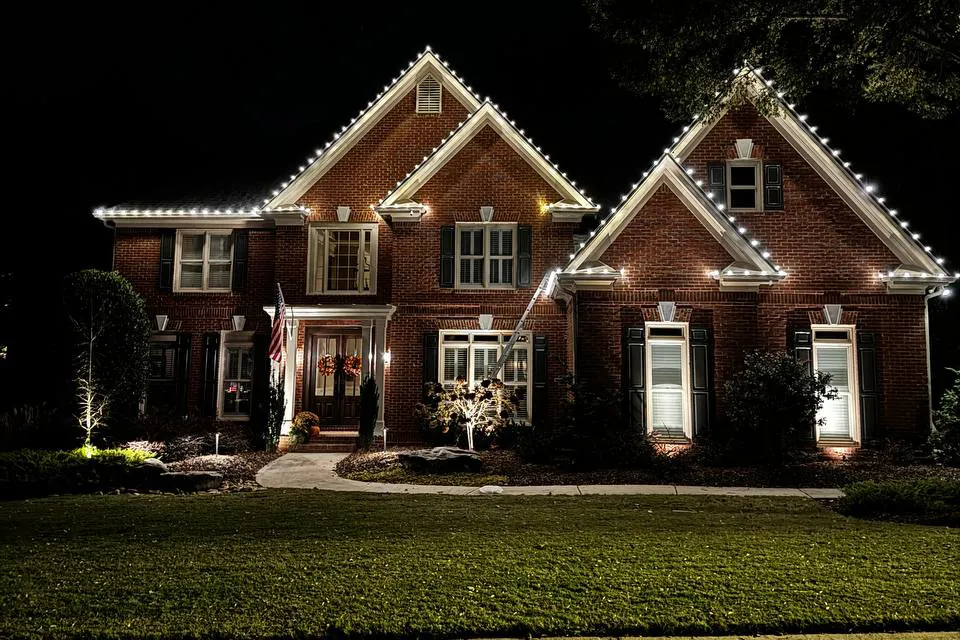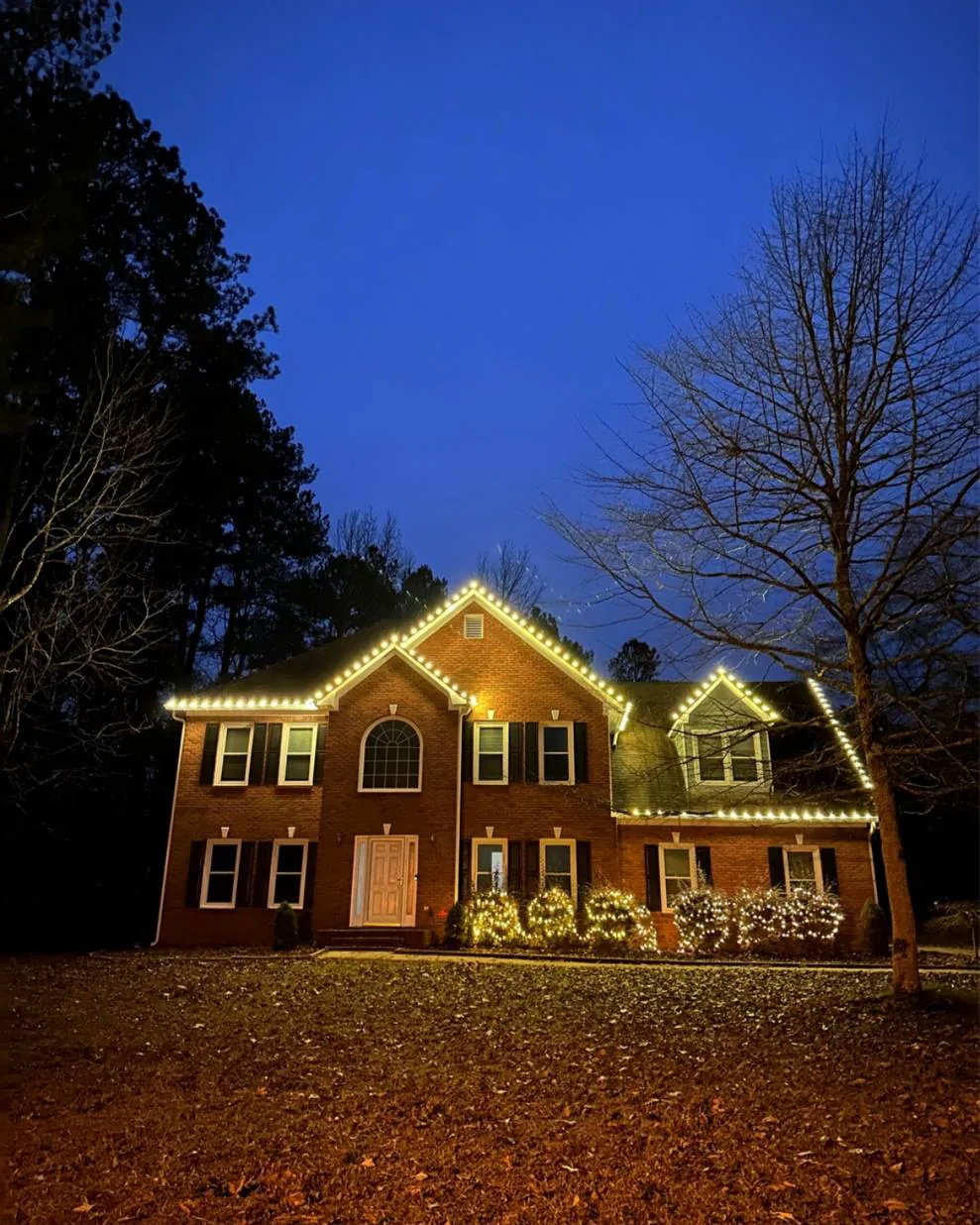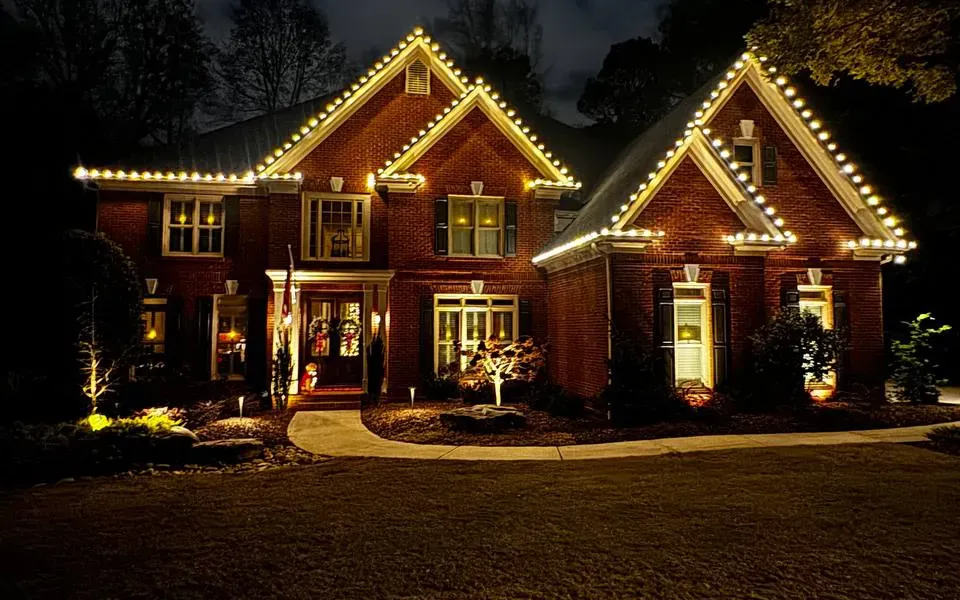
For a red or brown brick house, warm white is almost always the right choice. A warm white LED sits around 2700K, close to the glow of an old incandescent bulb, and it shares the orange and red undertones already in the brick. Cool white, which runs roughly 5000K to 6500K, carries a blue cast that tends to argue with red masonry and can make the wall behind it look flat and slightly gray at night. There are exceptions, and they are specific, so this note walks through how color temperature, bulb size, and spacing work together on brick.
What the numbers mean
Color temperature is measured in kelvin (K). Lower numbers are warmer and more amber. Higher numbers are cooler and bluer. Most holiday LEDs fall into a few rough bands:
| Label | Approximate range | How it reads on a house |
|---|---|---|
| Warm white | 2700K to 3000K | Soft amber, close to classic incandescent |
| Neutral or “pure” white | around 4000K | Clean, slightly bright, less amber |
| Cool white | 5000K to 6500K | Crisp, bluish, reads as icy |
Two warm white strands from different makers can still differ by a few hundred kelvin, which matters more than people expect. On a long gutter run, a slightly pinker or greener strand next to its neighbor shows up immediately from the street. It is one reason a roofline looks better lit with strands bought together than pieced together over several seasons.
Why warm white suits brick
Brick is rarely one color. Most of the brick on older Atlanta houses sits somewhere between orange-red, deep red, and brown, with mortar lines in cream or gray. Warm light picks up those undertones and gives the wall back some of its daytime color after dark. The effect is quiet. The roofline glows, and the masonry underneath it looks warm rather than lit.
Cool white does something different. Its blue component is not present in red brick, so the wall absorbs and mutes it, and the roofline ends up looking like a thin bright wire hovering above a dark facade. On a colonial with a strong cornice or a Tudor with steep gables, that separation loses the architecture you are trying to show.
This is why most of our residential design work on brick starts from warm white. It is also the basis of our warm-white roofline service, which is built around a single color temperature carried cleanly across every edge of the house.
When cool white is the better call
Cool white is not wrong. It is a specific look, and a few houses want it:
- Painted white brick. Once brick is painted white or pale gray, its warm undertone is gone, and cool white can look sharper and more intentional than amber against it.
- Gray stone and white stucco. Materials with blue or gray tones take cool white well.
- Contemporary houses. Flat rooflines, dark window frames, and minimal trim often suit the crispness of cool white.
- A frosted look on evergreens. Cool white on a magnolia or a row of hollies reads as frost, which some people want on a front lawn even when the house itself is warm.
The rule we follow is commitment. A display that is entirely cool white reads as a choice. A display that is mostly warm with one cool element tends to read as a replacement strand.
Can warm and cool be mixed?
Not on the same line. Two color temperatures side by side on one gutter look like a mismatch from any distance. Separating them by element is possible, such as warm white on the roofline and cool white wrapped through a stand of evergreens set well away from the house, but on brick we rarely recommend it. Multicolor is a different conversation altogether and suits some houses and families very well. It simply works on its own logic rather than as a blend of whites.
Bulb size changes how brick reads
Color temperature is half the decision. The other half is the bulb.
C9 bulbs
C9s are the larger of the two classic roofline bulbs. On a two-story brick house seen from across the street, they hold their shape as individual points of light, which gives the roofline rhythm. Most tall brick colonials and Georgian houses look best in C9s, because smaller bulbs at that height blur into a thin line.
C7 bulbs
C7s are smaller and a little softer. They suit one-story eaves, porch rooflines, bungalows, and brick cottages where the viewer stands closer to the house. On a Craftsman with low, deep eaves, C7s often look more in proportion than C9s.
Mini lights
Mini lights are for texture close to the eye: shrubs, porch railings, tree trunks, and wrapped columns. On a roofline, minis tend to disappear against brick at night. They are excellent on the trees and landscape in front of a brick house, where they add depth without competing with the roofline.
Spacing and line
On a roofline, bulbs are usually set on 12-inch centers, one bulb per clip. That spacing gives an even, deliberate rhythm, and on brick, where the eye already reads the regular pattern of the coursing, an even rhythm matters. Irregular spacing on a masonry house is more noticeable than on siding.
Line matters as much as spacing. The roofline should follow the actual edge of the house: the gutter on long runs, the rake on gables, the ridge where it is visible. On a Tudor with steep front-facing gables, outlining each gable edge carries the eye up the facade. On a hipped-roof colonial, one clean gutter line plus the dormers often reads more elegantly than trying to outline everything. The goal is a line that looks like it belongs to the building.
Everything is attached with shingle clips, gutter clips, or tension wraps. Nothing is stapled, nailed, or screwed into the brick, the mortar, or the trim.
The street view test
A roofline is judged from the sidewalk and from a car, not from the ladder. Before settling on a color and bulb, it helps to stand across the street at dusk and look at three things:
- How much of the house is brick versus trim. Heavy white trim on red brick can take either temperature on the trim edges, but the brick itself still prefers warm.
- How far back the house sits. Deep setbacks, common on the larger lots in Buckhead and Druid Hills, favor C9s so the line holds at distance.
- What the neighbors run. Not to copy them, but because a cool white house on a street of warm white houses stands apart, sometimes pleasantly and sometimes not.
On the smaller, closer-set brick and Craftsman houses in Virginia-Highland and Decatur, the viewer is nearer, so C7s and a tighter composition often make more sense.
Greenery and warm white
Wreaths and garland tie brick and light together in a way a roofline alone does not. A lit wreath on each upper window of a brick colonial, in the same warm white as the roofline, gives the facade a second layer of rhythm. Our wreaths, garland, and greenery work is almost always specified in the same color temperature as the house lighting for this reason.
If you want color some nights and warm white on others
Some owners of brick houses want warm white for December and color for other holidays or game days. That is the case for permanent roofline lighting, which can switch between a warm white setting and color. The quality of the warm white setting on a permanent system is worth looking at in person before choosing, since not every system renders a warm white that sits well against red brick.
Getting a recommendation for your house
The fastest way to settle warm versus cool is a photo. Text a picture of the front of the house, ideally taken from across the street, with the address to (470) 380-7797, or use the contact form. We will come back with a written, itemized quote and a recommendation on color temperature, bulb size, and where the line should run. At the end of the season, the lights come down in January and can be coiled, labeled, and stored through our takedown and storage service.