Lighting an older house in one of Atlanta’s historic districts comes down to two ideas: keep everything temporary, and let the architecture lead. Seasonal lights that clip on and come down in January are, in general terms, a different thing from a permanent change to a building, and a restrained warm white line that traces a Queen Anne gable or a Tudor roof tends to suit these houses better than heavy coverage. The rules for what needs review belong to the city or county and to each district’s guidelines, not to an installer, so this note explains the general picture and the design thinking, and points to where the real answers live.
Atlanta’s historic neighborhoods, briefly
Several of the neighborhoods we work in carry historic designations, and they are not all the same kind.
Inman Park was planned by Joel Hurt in the late 1880s and is often described as Atlanta’s first planned suburb. Its streets hold Queen Anne and Italianate houses alongside Romanesque details, bungalows, shotguns, and foursquares. It was listed on the National Register of Historic Places in 1973, and the City of Atlanta designated it a local historic district in 2002. More on the neighborhood is on our Inman Park page.
Druid Hills grew from a landscape plan by Frederick Law Olmsted, later refined by his stepson John Charles Olmsted, laid out around the chain of linear parks along Ponce de Leon Avenue. The whole historic suburb was listed on the National Register in 1979. The part inside the City of Atlanta is a city landmark district, and the part in unincorporated DeKalb County is a local historic district under DeKalb’s preservation ordinance. See our Druid Hills page.
Ansley Park was developed between about 1905 and 1908 by Edwin P. Ansley and is regarded as the first Atlanta suburb designed for the automobile, with wide, winding roads and green space in Winn Park and McClatchey Park reaching into the neighborhood. It was listed on the National Register in 1979. Our Ansley Park page covers how its houses tend to light.
National Register listing and local designation are different things. National Register listing is largely honorary for private owners. Local designation is what brings design review. In the City of Atlanta, changes to contributing buildings in locally designated districts can require a Certificate of Appropriateness from the Atlanta Urban Design Commission. DeKalb County has its own preservation commission and process for its districts.
Temporary vs permanent, in general terms
This is not legal advice, and we do not interpret ordinances for anyone. What we can describe is the practical difference between the two kinds of work we do.
Temporary seasonal lighting
A standard holiday installation is temporary. Commercial-grade LED strands are cut to measured runs and held with shingle clips, gutter clips, and tension wraps. Nothing is stapled, nailed, or screwed into the house. A timer is set at install. In January the crew takes everything down, and the house is left as it was found. Nothing about the building’s fabric has changed.
Permanent roofline lighting
Permanent roofline lighting is a mounted system that stays on the house all year. Because it is fixed to the building, it is an alteration in a way seasonal lights are not. On a house in a designated district, that is exactly the kind of change to raise with the reviewing office before installation. We would rather a homeowner ask first than find out afterward.
Who to ask
For a house inside the City of Atlanta, historic review runs through the historic preservation staff in the Department of City Planning’s Office of Design, with larger matters going to the Urban Design Commission. For the DeKalb County portion of Druid Hills, review sits with the county’s historic preservation commission. Neighborhood associations often publish their district guidelines and can point to the right contact. If there is any question about a specific plan, those offices are the authority.
Why older houses need a lighter hand
Historic houses carry details that newer houses do not, and those details change how an installation is planned.
Original materials
Old-growth wood trim, slate, clay tile, and soft lime mortar are all less forgiving than modern materials. This is the practical reason we never use fasteners. A clip that holds to a gutter edge or a shingle course leaves nothing behind. A staple in century-old trim leaves a hole that is still there after the lights come down.
Complex rooflines
A Queen Anne house might have a turret, a wraparound porch, cross gables, and decorative bargeboards. Trying to outline every edge of that roof produces a tangle of light. The better approach is to choose the lines that describe the house: the main gables, the porch eave, perhaps the turret’s base. Picking fewer lines makes the building easier to read.
Tall, steep roofs
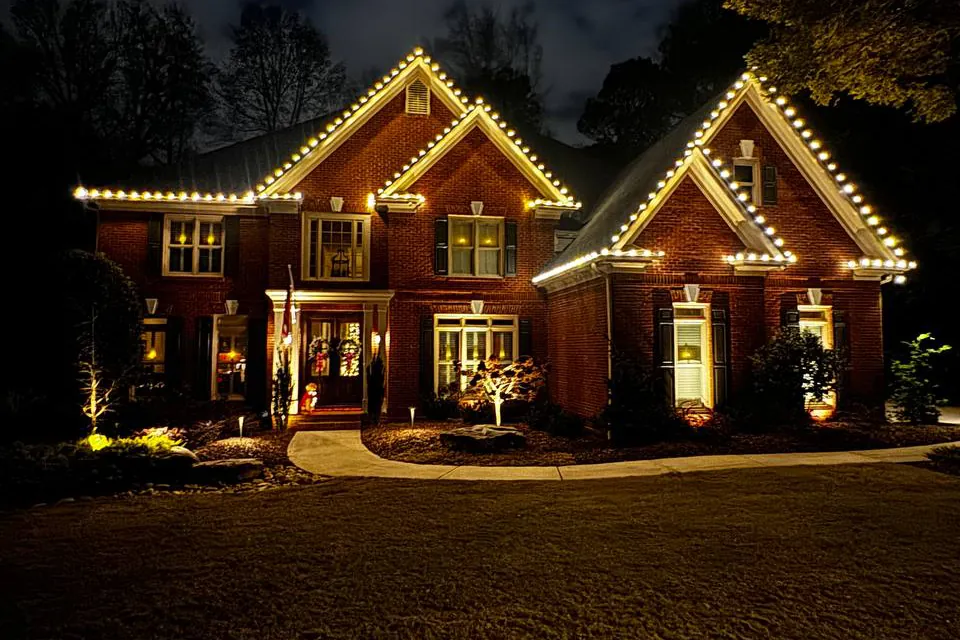
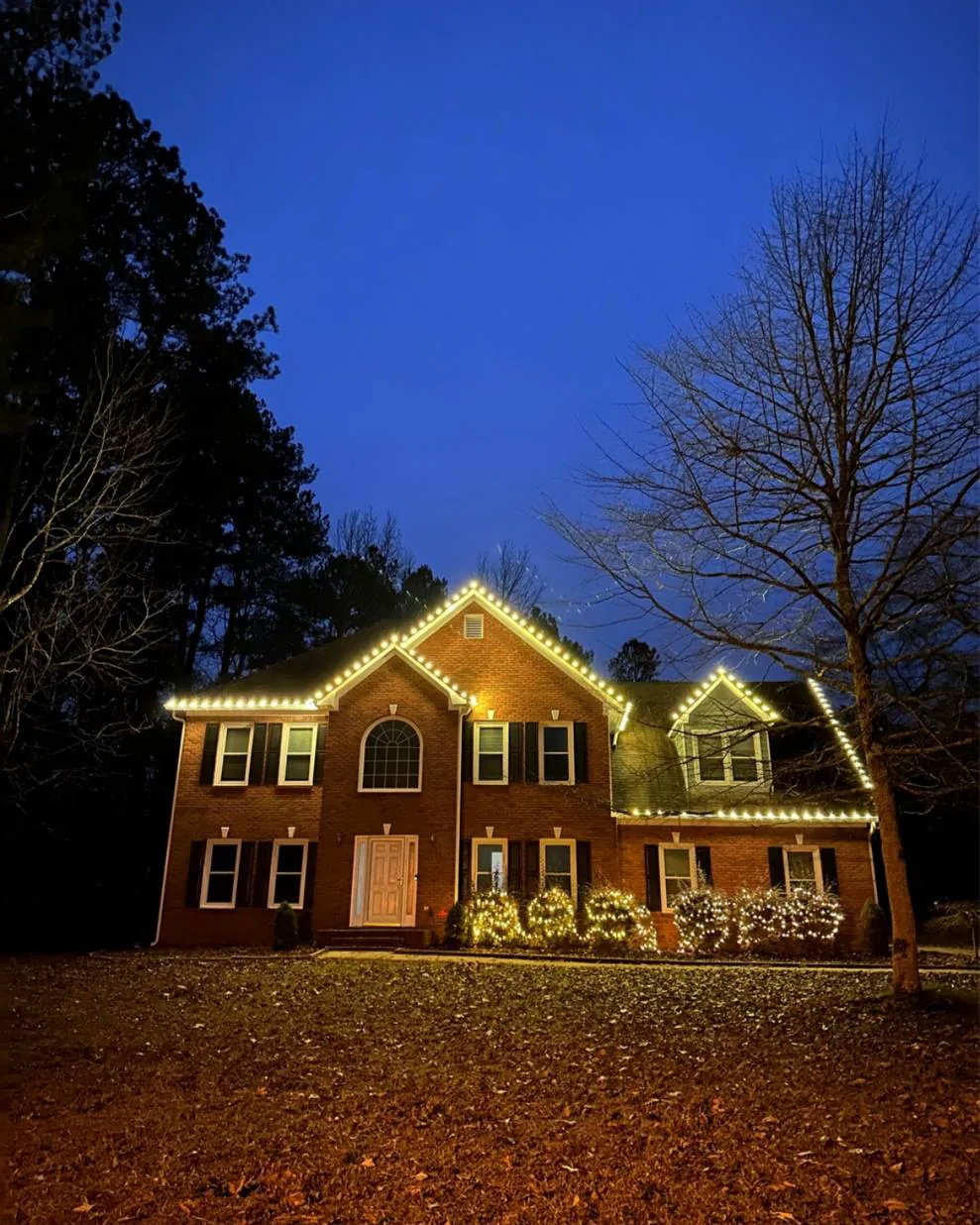
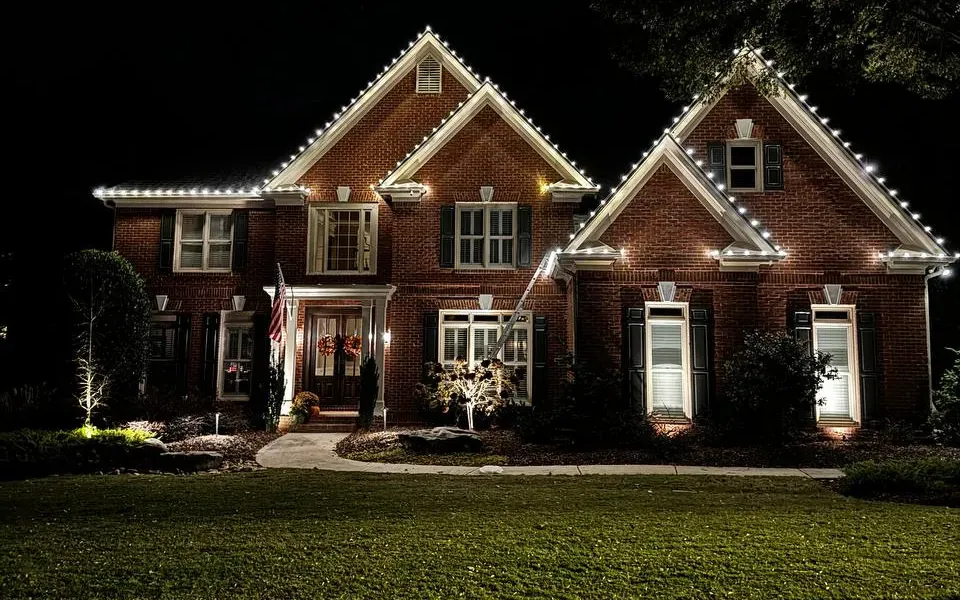
Tudor Revival houses, which turn up across Atlanta’s early 1900s neighborhoods, often have steep front-facing gables. A single line of C9s up each rake draws the eye up the facade and shows off the pitch. Adding a gutter line at the base of every gable can flatten that effect.
Design principles for historic houses
One warm color temperature
Warm white, around 2700K, sits comfortably with brick, painted wood, and stone, and it recalls the incandescent light these houses were first lit by. Our note on warm white vs cool white on brick goes deeper on this. Our warm-white roofline service is designed around carrying one consistent white across the whole house.
Match bulb size to height
C9s on tall gables and cornices, C7s on porch eaves and lower rooflines, and minis only where the eye is close, on railings, shrubs, and trunks. On a raised Victorian porch, C7s along the porch eave with lit garland on the rail often do more than a full roofline would.
Greenery at the entry
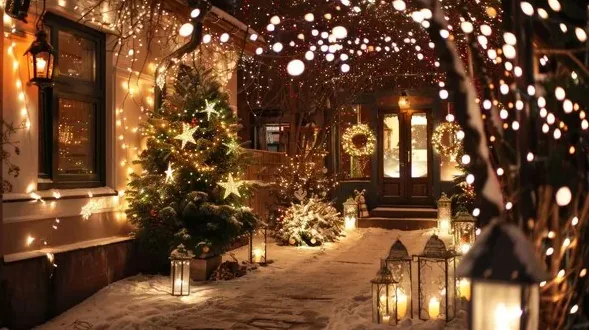
Many historic houses were designed around a formal entry. A wreath on the door, garland on the surround or porch columns, and matching wreaths in the front windows give the facade a composed, period-appropriate look. Our wreaths, garland, and greenery service handles this, often alongside a restrained roofline.
Let the trees work
Older neighborhoods have mature trees. Large oaks in front yards, and the parkland Olmsted’s plan left along Ponce de Leon Avenue in Druid Hills, set the scale of the street, and a single lit tree can carry a display on its own. Wrapping a trunk in warm white mini lights adds height and depth without touching the house at all. See trees and landscape lighting.
A sample approach
Consider a two-story brick Tudor Revival with a steep front gable, a smaller side gable, an arched front door, and a large oak in the yard. A restrained plan might look like this:
- Warm white C9s on the rakes of both gables, following the roof edge.
- No gutter line along the long side eave, so the gables stay the focus.
- A lit wreath and garland around the arched door, in the same warm white.
- Warm white minis wrapped up the oak trunk to the first major branch.
- A timer set at install, and January takedown.
Nothing in that plan fastens into the building. It all comes down in January, and it lets the house’s own shape carry the display.
Neighborhoods close by
Historic character is not limited to designated districts. Midtown keeps older houses on its residential side streets, and Virginia-Highland is full of Craftsman bungalows that reward the same careful approach.
Getting started
Text a photo of the house from across the street, plus the address, to (470) 380-7797, or send it through the contact form. We will come back with a free written, itemized quote and a plan that respects the architecture. Our installers have worked Atlanta rooflines since 2018, and we plan every older house on its own terms.