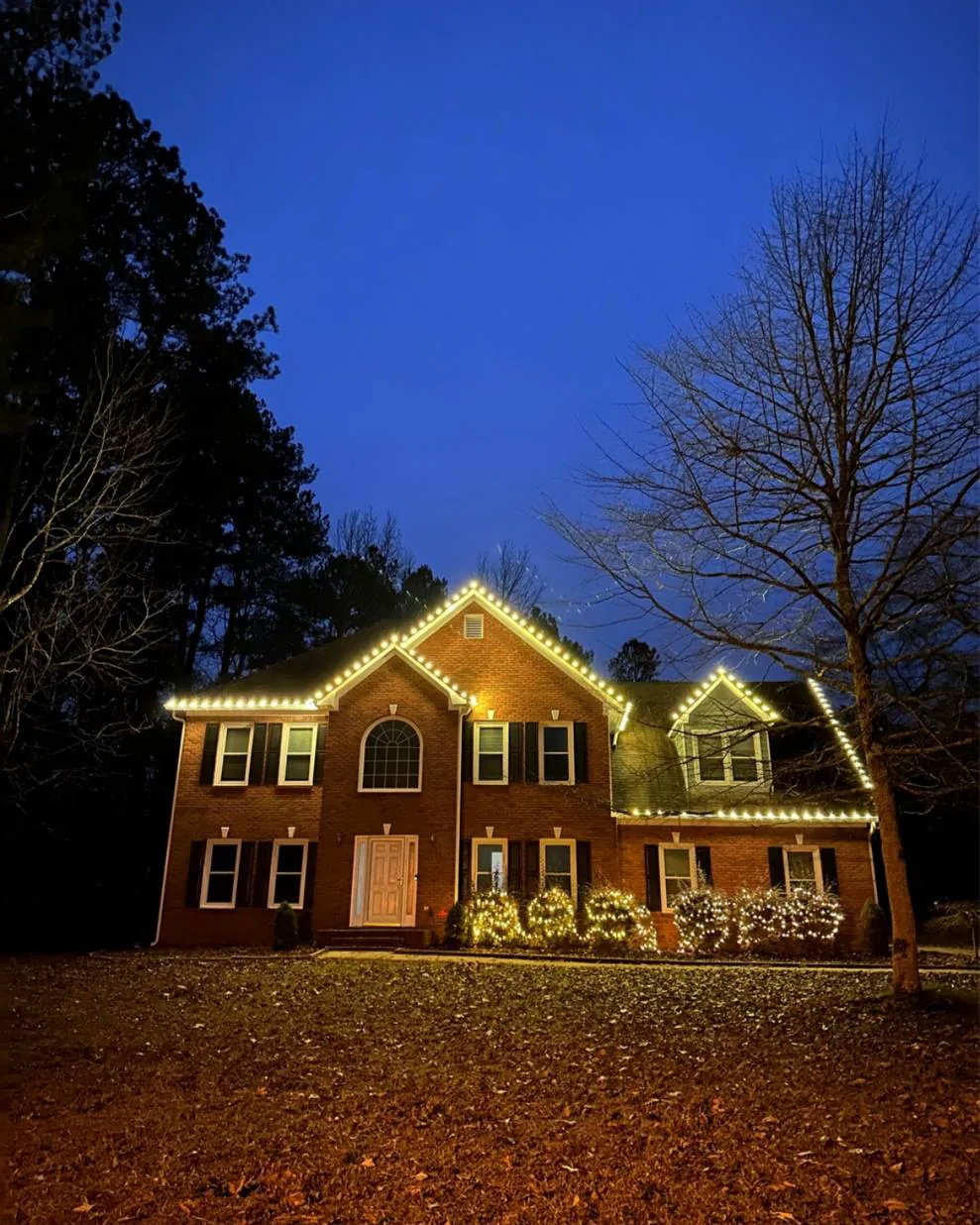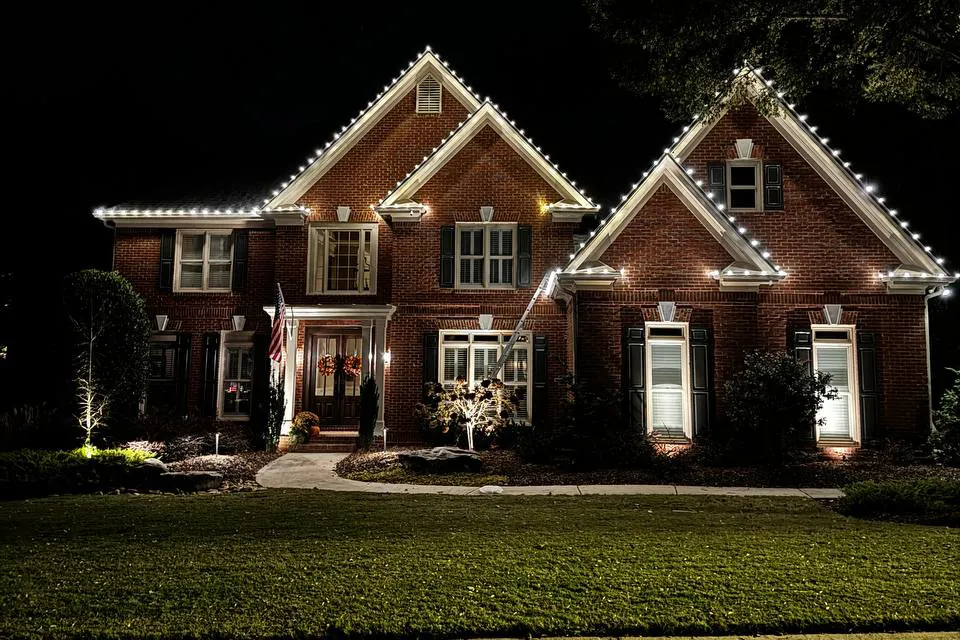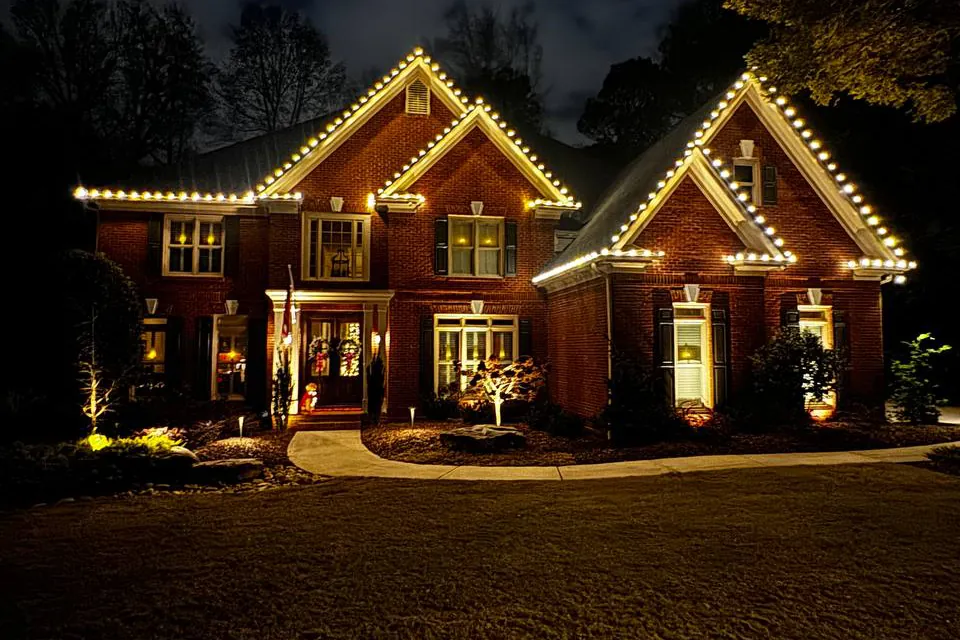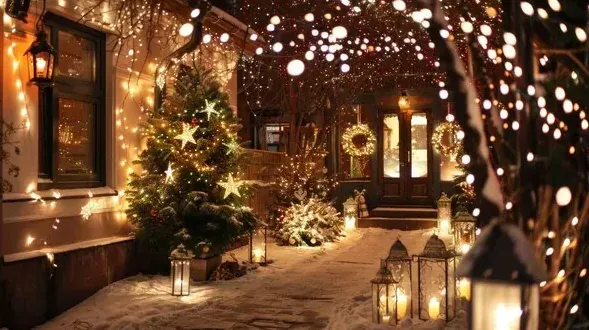
Good storefront holiday lighting is planned around one question: how does the business read from the street at dusk, to someone walking or driving past. For most Atlanta shops and restaurants that means lighting the entry and the building’s strongest lines, keeping signage clear, treating any patio as its own room, and running the lights on a timer tied to business hours. Book early, because the install season runs from late October to about mid-December, earlier dates fill first, and a landlord or property manager may need to approve the plan before anyone climbs a ladder.
Start with the view from the street
A storefront is seen quickly. A driver on Peachtree Road or Ponce de Leon Avenue has a few seconds, and a pedestrian has perhaps a dozen steps. The lighting has to say “open, warm, worth stopping” in that time.
That usually means three things lit in order of priority:
- The entry. The door is where the eye should land. A lit garland around the door frame or a pair of lit wreaths either side does more than lights anywhere else on the facade.
- The building’s main lines. A parapet, a canopy edge, a cornice, or the eave of a converted house. One clean line of warm white along the top of a storefront gives it shape after dark.
- Windows. Lit greenery or wreaths in the display windows frame what is inside without competing with it.
Everything beyond those three is optional, and on many storefronts less is more.
Keep the sign legible
The sign is the most important thing on a commercial facade, and holiday lighting should never obscure it. That means no strands draped across letters, no bright runs directly above an illuminated sign that wash it out, and no greenery hanging in front of a blade sign. We plan the lighting so the sign sits inside the composition, often framed by the canopy line above and the entry below.
Color temperature matters here too. If the sign is lit in cool white or a brand color, a warm white roofline beside it can make the sign look off. Warm white suits most brick and wood storefronts, and it is the default for our storefronts and restaurants work, but a business with a crisp modern facade and a cool-lit sign may be better served by cool white. Our note on warm white vs cool white covers the tradeoffs.
Restaurants and patios
Restaurants add a second audience: the people sitting outside.
Light for the diners, not just the street
A patio is a room without a ceiling. String lights overhead give it one. The lights should read as warm and even from the table, which usually means warm white on overhead runs and nothing glaring at eye level. Wrapped trunks and lit planters at the edge of the patio define its boundary from the sidewalk.
Keep walkways clear
Cords run where people walk are a hazard. We route power along walls, rails, and planters, and keep strands above head height or tight against the structure. Anything near a walkway should be secured so a coat or a bag cannot snag it.
Coordinate with service
Installs at a restaurant go best outside service hours. Tell us when lunch and dinner run and we plan the visit around them where the schedule allows, without blocking patio seating or the entrance while guests are there.
Match the patio to the dining room
The patio lighting should feel like part of the restaurant, not a separate display. If the dining room is lit warm and low, the patio should be too. A single warm white string pattern overhead, repeated at a steady spacing, reads calmer than several kinds of light competing for attention.
Approvals and practical checks
Before booking, it helps to confirm a few things:
- The lease. Many commercial leases restrict what can be attached to a facade, canopy, or shared structure.
- The property manager. Shopping centers and mixed-use buildings often have their own rules for holiday decor and approved install dates.
- Power. Where the outdoor outlets are, whether they are GFCI protected, and whether they are switched or always on. A timer is set at install.
- Shared walls and canopies. In a row of storefronts, the canopy may be shared with a neighbor. The line should stop cleanly at the property edge.
We attach with shingle clips, gutter clips, and tension wraps. Nothing is stapled, nailed, or screwed into the building. That is usually the first thing a property manager wants to hear.
Timing for businesses
The install season runs from late October to about mid-December, and earlier dates fill first. Businesses tend to want lights live before the shopping and holiday party stretch, which puts their preferred install dates at the busy front of the season. Add the time it takes to get a landlord’s approval, and the right time to start is early fall. Our post on how far ahead to book walks through the calendar.
Materials that hold up to a season of foot traffic
Commercial-grade LED strands are cut to measured runs, so there is no bundle of spare wire tucked behind a downspout. C9s suit tall facades and parapets. C7s work on lower canopies. Mini lights belong in greenery, on railings, and on tree trunks. Our wreaths, garland, and greenery work often does the most for a small storefront, since a lit wreath and garland at the door is visible from the curb and needs little else.
Trees in planters and along the sidewalk edge can be wrapped in warm white minis, which adds height to a one-story storefront. See trees and landscape lighting.
If you want lighting all year
Some businesses want a lit roofline beyond December, for other holidays, events, or simply as part of the building’s evening look. That is what permanent roofline lighting is for. It is a mounted system, so it is worth clearing with the landlord and, in a historic district, with the relevant reviewing office before installation.
During the season
A dark section over the entrance of a restaurant in December is noticed fast. If a run goes out, text a photo of the dark section to (470) 380-7797 and it goes on the next service route.
In January
Takedown happens in January. Lights are coiled, labeled, and stored until next season through our takedown and storage service, which means no bins of tangled lights in a stockroom that has no room for them.
Where we light storefronts
We work with storefronts and restaurants across intown Atlanta and the close-in neighborhoods, including the commercial streets of Midtown, Buckhead, Virginia-Highland, Inman Park, and Decatur. Each has a different streetscape. Virginia-Highland’s shops sit close to the sidewalk in low buildings, while commercial frontage set back behind a parking lot, as much of it is along the main roads through Buckhead, needs larger bulbs to read.
Getting a quote
Text a photo of the storefront, taken from across the street at dusk if possible, plus the address, to (470) 380-7797, or use the contact form. We will come back with a free written, itemized quote. What moves the number is footage, height, the number of wreaths and garland pieces, any trees or planters, and how dense the design is. Our installers have worked Atlanta rooflines since 2018.